WPP Timeline

1953

  • Literate women are granted the right to vote and run for parliamentary elections.
  • Emilie Ibrahim becomes the first woman candidate for the parliamentary elections.

1957

  • All women and men are granted the right to vote.

1963

  • Mirna Boustany is the first woman to be successfully elected to parliament[1].
  • Women were granted the right to vote and to run as candidates in the municipal elections.

1991

1 woman (Nayla Mouawad) is elected to parliament.

1992

3 women (Nayla Moawad, Bahia Hariri and Maha Khoury Asaad) are elected to parliament.[2]

1996

3 women (Nayla Moawad, Bahia Hariri and Nouhad Souaid) are elected to parliament.

2000

3 women (Nayla Moawad, Bahia Hariri and Ghinwa Jalloul) are elected to parliament.

2004

2 women (Leila Solh and Wafaa Hamza) are appointed as ministers, for the first time.

2005

  • 6 women (Bahia Hariri, Nayla Moawad, Ghinwa Jalloul, Gilberte Zouein, Strida Geagea and Solange Gemayel) are elected to parliament in the first parliamentary elections taking place after the assassination of PM Rafic Hariri, and the withdrawal of the Syrian troops. This was the highest number of women MPs entering parliament to date.
+ Read More
  • 1 woman (Nayla Mouawad) is appointed Minister.
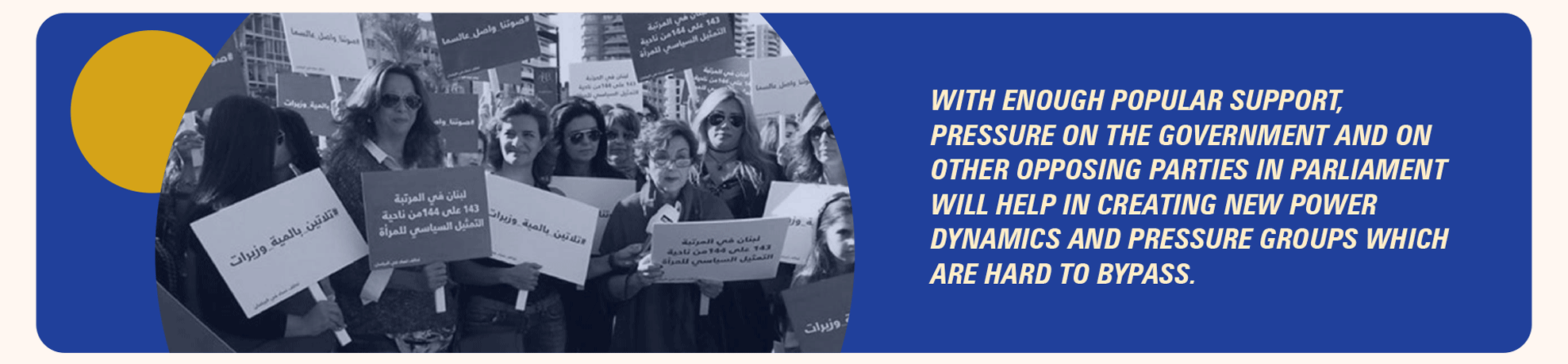
  • The Boutros Commission’s draft law[3] proposes a 30% quota for women’s participation in parliament. One woman – Arda Ekmekji – was selected to be on the Boutros Commission out of the 12 members.

2008

1 woman (Bahia Hariri) is appointed Minister.

2009

  • 4 women (Bahia Hariri, Gilberte Zouein[4], Strida Geagea[5] and Nayla Tueni[6]) are elected to parliament. The number of women in parliament dropped from six in 2005, to 4 in 2009.
  • 2 women (Rayya El Hassan and Mona Ofeich) are appointed Ministers.

2010

The then minister of Interior and Municipalities Ziyad Baroud proposes two draft laws for a women quota in the Municipal elections.
+ Read More
The first law establishes a 30% quota for women on candidate lists, while the second dedicates 20% of seats for women in the council. The laws did not make it to the general parliamentary session to be voted on.

2011

Minister of Interior and Municipalities Marwan Charbel proposes a new electoral law dedicating a 30% quota for women in parliament. The quota clause was rejected.

2014

1 woman – Alice Shabtini – is appointed Minister.

2016

1 woman – Inaya Ezzeldine[7] – is appointed Minister.

2018

  • 113 women ran for the parliamentary elections – less than 15% of the total of candidates. Only 86 out of the 113 were selected on electoral lists[8].
  • 6 women (Paula Yacoubian, Rola Tabsh Jaroudi, Bahia Hariri, Strida Geagea, Inaya Ezzedine, Dima Jamali) are elected to parliament.

2019

  • 4 women (Nada Boustani, May Chidiac, Raya Haffar Al Hassan and Violette Khairallah Safadi) are appointed Ministers.
  • Raya Haffar Al Hassan becomes the first woman Minister of Interior and Municipalities in Lebanon and the Arab World.

2020

For the first time, 30% of ministers in the newly appointed government are women, with 6 women ministers out of 20, marking the cabinet with the highest number of women ministers to date.

2021

  • 1 woman (Najla Riachi) is appointed Minister.
  • NGO Fifty-Fifty proposes a draft law to allocate 26 seats in parliament for women in the 2022 parliamentary elections.
+ Read More
  • The National commission for Lebanese Women (NCLW) proposes a draft law to allocate 24 seats in parliament for women.
  • MP Inaya Ezzedin adopted Fifty-Fifty’s quota proposal but MPs refuse to discuss it.

2022

  • 157 women run for the parliamentary elections – only 15% of the total number of candidates.
+ Read More
  • 8 (Halima Kaakour, Najat Aoun, Paula Yacoubian, Cynthia Zarazeer, Inaya Ezzedine, Nada Boustany, Sethrida Geagea, Ghada Ayoub) women won seats in parliament, 4 of whom are among the opposition “Change MPs”.
  • Women make 6% of the Lebanese parliament today, the highest in the country’s history.

7 Dec 2023

  • 10 MPs (out of 128) from across political parties signed a gender quota law proposal for municipal council elections.
+ Read More
(The signed law proposal will be introduced to the agenda of the relevant parliamentary committees for further discussion and approval, before being submitted for endorsement during the plenary parliamentary sessions).
Contextual Update

This mapping covers the situation in Lebanon up to November 2024. It was written at a time when the country had been under ongoing war since 2023. Since September 2024, Israel expanded its military aggression against Lebanon, launching hundreds of airstrikes across South and the Bekaa, as well as targeting the capital and its southern suburb. Crimes of genocide and against humanity were perpetrated by Israel. These attacks included the destruction of towns and residential areas, detonation of thousands of electronic pagers and communication devices, killing journalists, medical first aid providers and civilians.

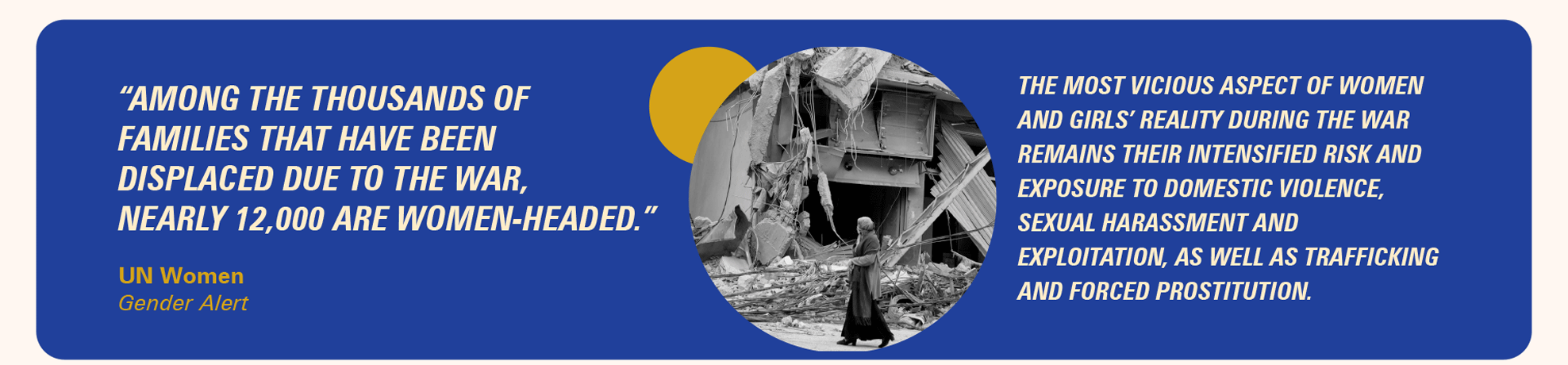
These aggressions had led to the displacement of approximately one million individuals, nearly one third of the population, many of whom have sought refuge in public schools and institutions converted into makeshift shelters.

According to the Lebanese Ministry of Health, between October 8, 2023 and November 28, 2024 the death toll reached 3,670 martyrs and 15,413 people injured.

+ Read More

A ceasefire agreement officially came into effect on November 28, 2024; however, thousands of violations from the Israeli side have been reported since.

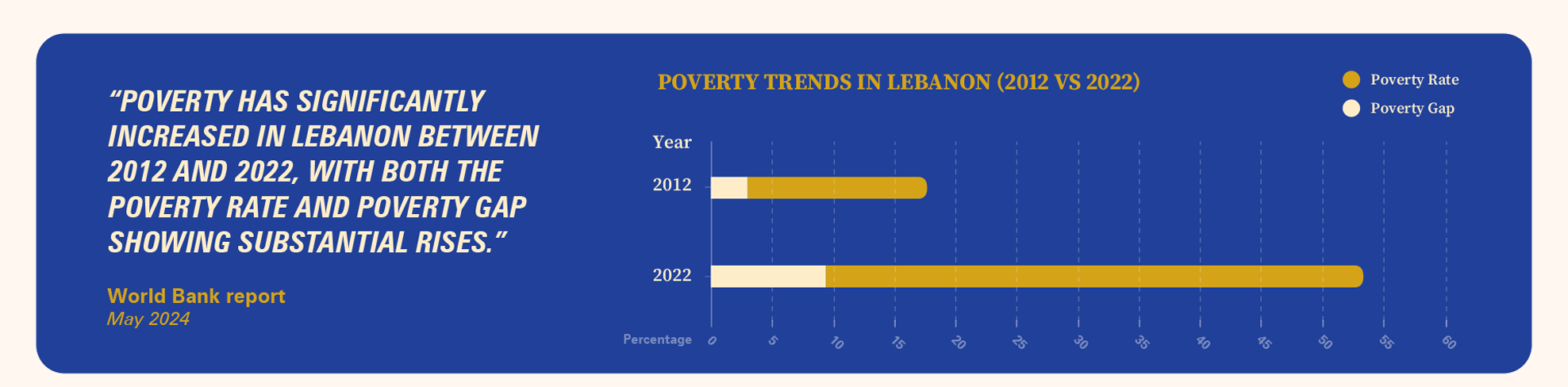
This war unfolded against the backdrop of longstanding structural challenges, including an oligarchic governance, a financial and economic collapse and the devaluation of the local currency since 2019. These conditions have significantly exacerbated vulnerabilities, particularly for women, in particular displaced girls and women head of households.

Women and girls in shelters face intensified risks of domestic violence, sexual harassment and exploitation, trafficking and forced prostitution, and limited access to basic necessities.

Prior to the war in 2024, there had been a rise in discrimination against individuals and groups in vulnerable situation, including forced deportations of Syrian refugees in Lebanon and increased attacks targeting LGBTIQ communities. Public discourse became increasingly hostile, with prominent figures contributing to a wave of hate in response to a draft bill proposed by nine members of parliament to decriminalize homosexuality. This was accompanied by incidents such as attacks carried out by extremist groups against queer friendly places in Beirut.

In the area of women’s political participation, the escalation of the war in 2024, shifted the focus of civil society organizations and media platforms working on political reform and women’s political participation. Their efforts increasingly highlighted Israeli violations of international law (Seeds for Legal Initiatives, KAFA), the violence that women endure and their voices in conflict and war (Seeds, Maharat, Abaad, Fe-Male, and KAFA), as well as the hardships that women journalists bear while covering the war, focusing on Lebanese journalists lost to the Israeli war, and those who are working under fire (Fe-Male, Maharat).

Although resistance to women’s political participation in Lebanon is rooted in structural issues, discussions around pathways to redress it have long centered on the absence of women’s quotas in government positions and parliamentary and municipal elections. Hence, the aim of the AiW’s policy map on women’s political participation is to document the arduous struggle between the government, political parties, and women’s rights activists and organizations over the parliamentary quota. The battle for the quota exemplifies the struggles of Lebanese for equal rights and recognition.

The Issue

According to UN Women’s map of women in politics for 2024, Lebanon ranks 181 out of 184 countries, with only one woman appointed as minister. In the World Economic Forum’s Gender Gap Report for 2024, Lebanon ranked 142 out of 146 countries in political participation.

Current Context (2024)

Lebanon ranks 181/184 in women’s political representation. Political participation remains extremely low, with women occupying only 6% of parliamentary and 4% of ministerial positions as of 2022.

Historical Overview

Since 1953, only 17 women were elected to parliament as of 2021. 2022 marked a shift with 8 women elected, 4 of whom were independent “Change MPs”.

+ Read More
Historically, these women did not carry a feminist agenda. The current coalition of 12 “Change MPs” focuses on challenging sectarian grip, though they do not share a collective feminist agenda.

CEDAW

Lebanon did not place any reservations on Article 7 of CEDAW. Despite this, governments have failed to implement a parliamentary quota.

2005

The Boutros Commission proposed a 30% women’s quota on party electoral lists. The proposal was rejected but established 30% as the political ceiling.

2008

Researcher Kamal Feghali, supported by NGOs, helped develop two distinct proposals for a women’s parliamentary quota.

2010

Minister Ziad Baroud submitted proposals for a 30% quota on party lists and a 20% quota on municipal councils ahead of municipal elections.

2011

The Civil Campaign for Electoral Reform (CCER) proposed increasing the quota ceiling to 33.33%, suggesting one woman for every three men on each list.

2021

The NCLW proposed a quota law establishing 26 seats in parliament, divided equally between Christians and Muslims.

2022

Fifty-Fifty and 12 experts drafted a law for a 26-seat quota and 40% candidate reservation, adopted by MP Inaya Ezzedine but dismissed by committees on Oct 7, 2021.

Structural Challenge:

Historically, women have been largely unable to crack the political glass ceiling in the country because of its patriarchal sectarian system, which “naturally discriminate[s] against women, as its only function is to reproduce political elites—political families and sectarian parties”. (Dagher, 2021). The “patriarchal sectarian system” can be broken down into several aspects: a sectarian governance system, the grip of religious institutions on personal status laws, the patrilineal citizenship, and a kinship system prevalent in all spheres of life (families, the market, and governmental institutions). These aspects are in turn indications of an ambivalent and contradictory relationship that Lebanese women have with the state.

 Read More

By relegating personal status matters to sectarian courts—notorious for invariably upholding a patriarchal bias—the Lebanese state abstains from assuming its full responsibility towards women.

the women fielded on electoral lists and appointed to cabinet are often picked by political leaders and gatekeepers based on sectarian quotas and are hence expected to follow their sectarian party’s agenda. Most importantly, most of these women are closely connected to strong political figures: husbands, fathers, or brothers.

Types of contestation


Municipal elections rescheduled for several rounds: visuals to reflect the dates and causes of postponement :

The municipal elections which were meant to take place around the same time as the parliamentary elections in May 2022, were postponed.

 Read More

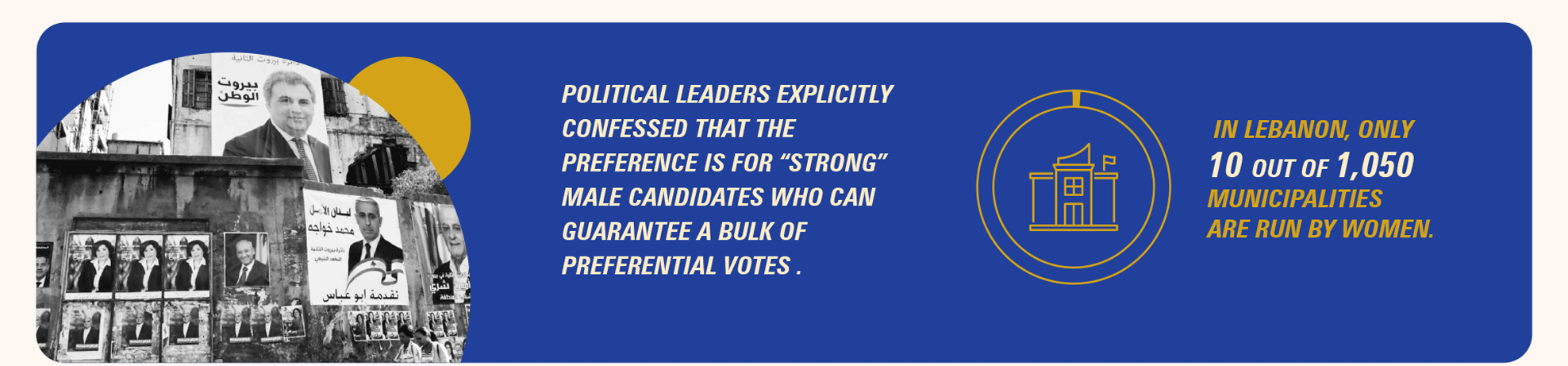
The first round of postponement – which rescheduled the elections for May 2023, was claimed to be related to logistical concerns and the ministries’ inability to organize both elections at the same time. In April of 2023, the parliament voted to extend the terms of municipal councils and other local authorities for another year, thus delaying elections a second time. With a government barely operating in a limited caretaker capacity, lawmakers framed this delay as a “technical extension” until May 2024, as funding for organizing elections had not yet been secured by the state. In April 2024, the excuse was the war in South Lebanon, and the verdict was postponing for a third time to May 2025. These delays hinder women’s groups’ advocacy for a quota since the elections have been a long-awaited milestone that women’s groups advocating for a quota anticipated, especially that out of 1,050 municipalities, only 10 are run by women. Similarly, no discussions on the quota have been reported in parliament or in parliamentary committees in the timeframe between April and December 2023.

Municipal Elections: A History of Postponement

Scheduled for May 2022, elections were postponed to 2023, then 2024, and now May 2025.

+ Read More

Reasons ranged from logistical concerns to the South Lebanon war. Out of 1,050 municipalities, only 10 are run by women. These delays critically hinder advocacy for a parliamentary quota, as these elections were a milestone for women’s political mobilization.

Political Systems & Barriers

Consociational Democracy: The sectarian power-sharing system partitions offices on a confessional basis, consolidating political familism and paternalistic authority.

Electoral Tactics: Parties use sectarian fearmongering. Preferential votes are prioritized, and fielding “strong” male candidates is seen as necessary, while women are often viewed as “counter-productive” to these tactics.

Types of Backlash

  • Bureaucratic: Inaction and active stalling in parliament.
  • Co-option: Falsely promising to lobby for quotas to silence opposition.
  • Status & Doctrinal: Resistance rooted in traditionalist views that women’s participation threatens “traditional values.”
+ Read More

Following Htun and Weldon’s typology, the backlash against women is characterized by the need to uproot old-guard patriarchal values.

Internal Barriers: Women’s Rights Organizations

The movement suffers from competing relationships and a failure to converge on a unified vision for empowerment.

+ Read More

Some groups lobby for representation within existing political parties—criticized by others as tokenistic—while feminist activists argue that quantitative approaches are reductive because they do not address the inherently anti-feminist, sectarian structure of the institutions themselves.

Actors

Drivers

Low political participation of women is a manifestation of a complex patriarchal matrix that has subdued women since the inception of the Lebanese state. Joseph (1993, 2005, and 2011) theorized and discussed at length some of the notions that underlie the Lebanese state-building project. Three notions are fundamental to adequately introduce it: Patriarchal connectivity, the kin contract, and political familism.

 Read More

Low political participation of women is a manifestation of a complex patriarchal matrix that has subdued women since the inception of the Lebanese state. Joseph (1993, 2005, and 2011) theorized and discussed at length some of the notions that underlie the Lebanese state-building project. Three notions are fundamental to adequately introduce it: Patriarchal connectivity, the kin contract, and political familism.

Patriarchal connectivity, Joseph contends, is a cornerstone of this matrix. It finds its roots in connective selfhood (Joseph,1993). Connective selfhood describes the fluid construct of self among Arab families that defines itself in relation to others and considers intimate others as extensions of itself. It refers to a culturally normative pattern of male and female relationships in Arab families that center-stages familial relations, and links kin and non-kin dynamics in historically, culturally, socially, politically, and economically specific contexts.

“Coupled with patriarchy, connectivity organizes the selves with fluid boundaries in a gendered and aged hierarchy, in a culture that valorizes kin idioms in all relations” (Joseph, 1993). Because of this family-embedded patriarchy, men and elders are entitled to direct the lives of women and juniors and have legally recognized rights and responsibilities in relation to them. Resultantly, kin groups and extended families are recognized as legitimate political actors in Lebanon and as a haven that the Lebanese turn to for protection and resources under a weak incapacitated state. Under a frail state, kin became the anchor of security for Lebanese citizens who used idiomatic kinship in all realms of life: the market, the workplace, and politics.

This gave rise to the “kin contract” (Joseph, 2005). This is the formal and informal understanding that membership in families precedes and preempts membership in the state, and that families can legitimately claim prior loyalty of their members, over and above the state. State actors, political leaders, and militias thus turned to families to mobilize and organize the population; mobilized their own kin, and deferred to the citizens’ kin in matters of relevance to the state, and the law. In this configuration, the political leader is seen as a family member and as an honorary family patriarch, which has paved the way for all leaders to present themselves as the senior patriarchs of the extended political family, calling for the loyalty, deference, and service due to them as heads of families.

This arrangement has multiple consequences: it validates the patriarchal extended kinship as a venue of social and political control, which is the most significant deterrent to Lebanese women’s positioning as full citizens; it confirmed the state’s legitimation of the primacy of kin; and justified the state’s mobilization of religion to sanctify extended kinship. Joseph argues that the kin contract is based in the care/control paradigm (Joseph, 2005). Members receive care from the extended kin but have to accept the presumptions of patriarchal control in return.

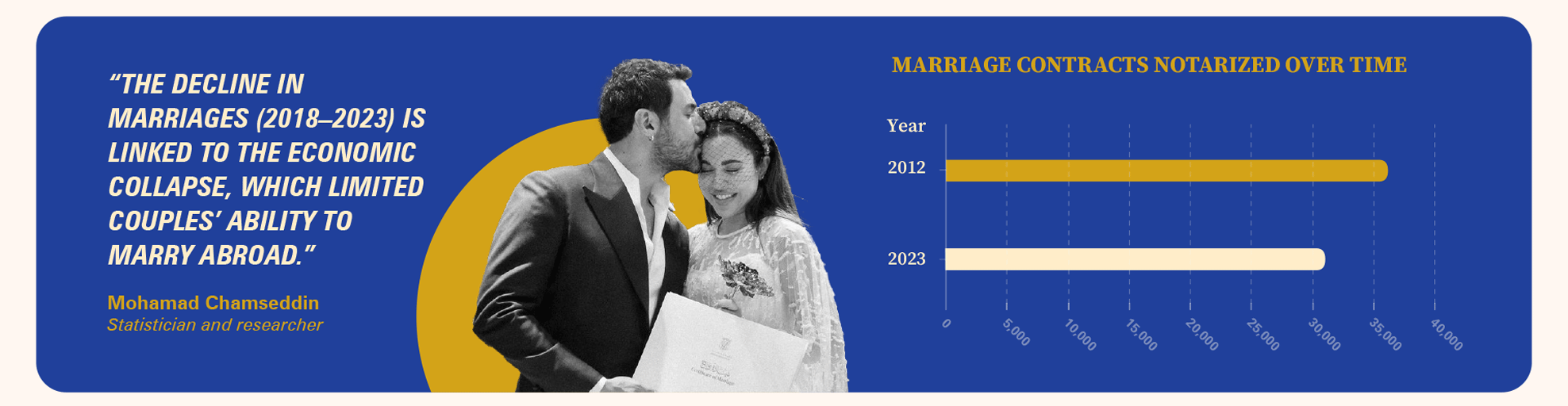
This partly explains why most political parties in Lebanon are most often based in family allegiances, and why and how political leadership continued through familial lines – usually passed down from father to son and occasionally to wives or daughters.


Political familism highlights the heavy reliance of Lebanon’s political system, in particular its confessional nature, on the “deployment of family institutions, ideologies, and idioms, practices and relationships by citizens to activate their needs and demands in relation to the state…and by the state/state actors to mobilize practical and moral grounds for governance based on a civic myth of kinship and a public discourse that privileges family.” This system reifies and perpetuates normative gender roles wherein women are constructed as dependents on their male family members and husbands, who are ideologically constructed as the “protectors” and “leaders” of their families. As such, women are ideologically and materially locked out of positions of political power, among other rights.


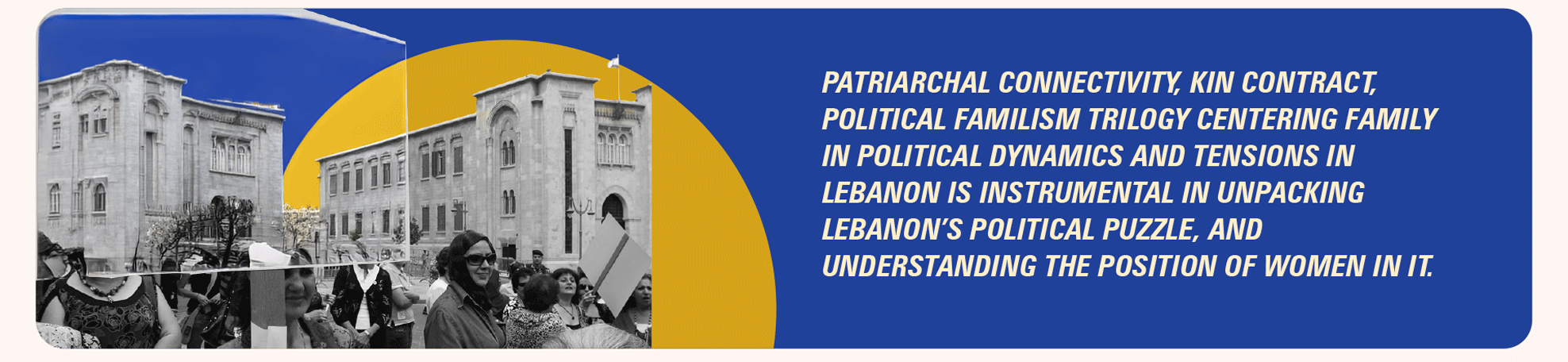
The trilogy of patriarchal connectivity, the kin contract, and political familism, which centers the family in Lebanon’s political dynamics and tensions, is instrumental in unpacking the country’s political puzzle and understanding the position of women within it. It also contributes to understanding the heteronormative power dynamics and make-up of families, the flowing of these dynamics into wider communities, and how the care-control paradigm is embedded in the political realm in Lebanon. Women’s quotas challenge these dynamics and disrupt the flow of family-based patriarchy traveling from the domestic to the governmental/ political. This patriarchal and heteronormative system is upheld by oppressive legal structures such as the sectarian personal status laws that ensure the subjugation of women within the family.

Spaces

 Read More

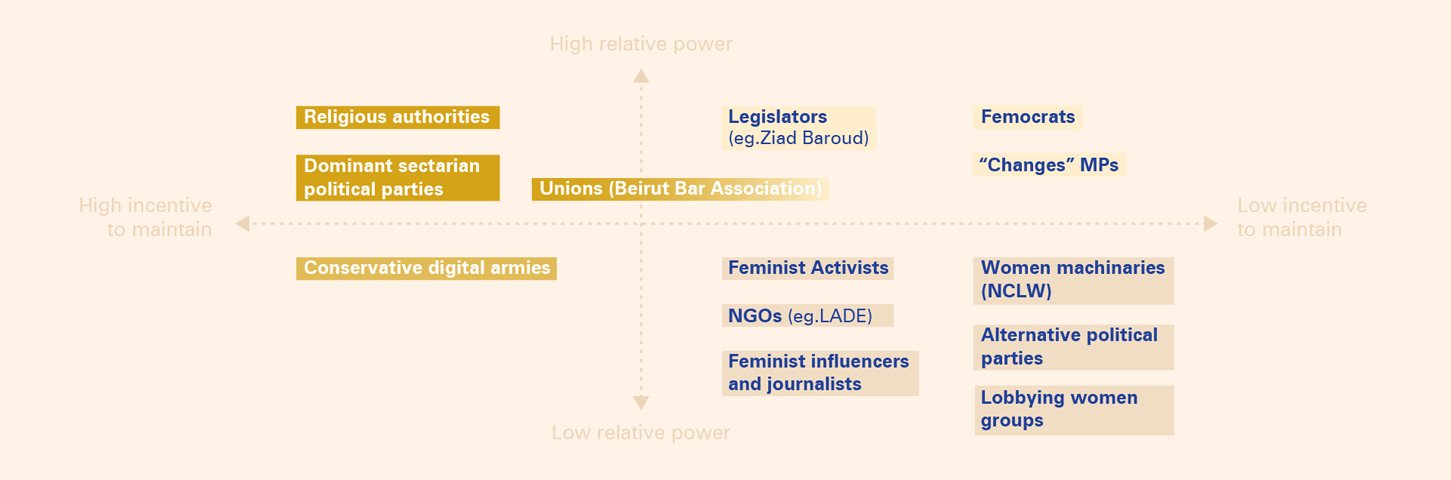
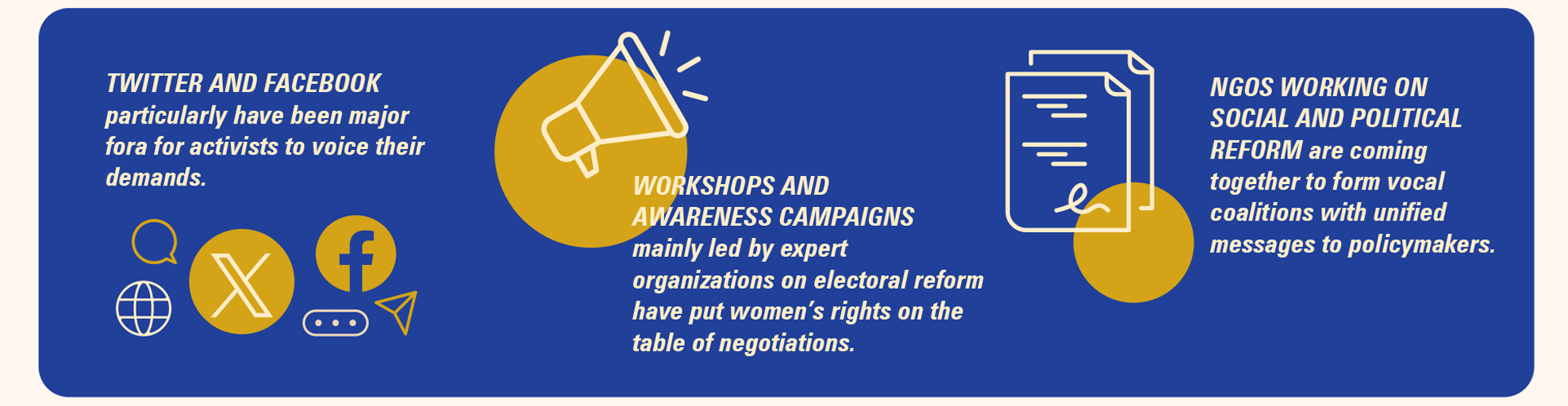
Social media platforms: X and Facebook particularly have been major fora for activists to voice their demands through hashtags, videos, and other posts supporting their cause. Orchestrated digital armies of dominant political parties, and of religious conservative forces are also rampant in these fora.


Workshops and awareness campaigns: organization of regular workshops and the formation of alliances to enhance women’s political participation. In the lead-up to the 2018 elections, LADE initiated the “National Alliance to Support the Political Participation of Women in Lebanon,” a coalition of over 100 non-governmental organizations, women’s groups, and activists that served to lobby political leaders to incorporate a 30% women’s quota in the electoral law.

NGOs working on social and political reform: are coming together to form vocal coalitions with unified messages to policymakers. Though these coalitions and spaces do not lobby for women’s rights per se, their approach mainstreams gender and women’s political rights in the overall vision for change and reform. These NGOs are active through workshop on the importance of women’s political participation, the proposal of draft bills to introduce a quota system for women in electoral laws, and the production of knowledge and documentation on the various forms of violence and barriers faced by women candidates.

Television talk shows on mainstream media channels: The past decade has seen a rise in the debate-based talk show genre on Lebanese televisions. These shows typically invite representatives of political parties to debate with representatives of alternative political parties and/or civil society organizations contending issues such as the lowering the voting age from 21 to 18, and women’s political participation and the quota.

Feminist activists and organizations have been protesting for different intersectional causes, including women’s political participation. The latest and most prominent of all movements has been the October 17, 2019 revolution.

Feminist student clubs at several university campuses,

have often served as crucial entry points that civil society organizations and women’s rights groups used to promote issues such as women’s political participation and the quota.

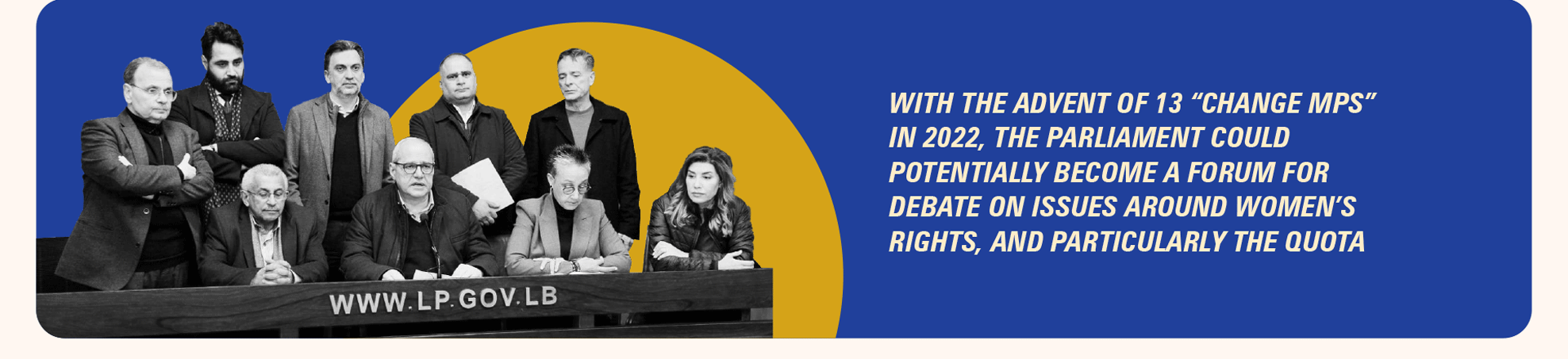
The parliament with the advent of 13 “Change MPs” to parliament as a result of the 2022 parliamentary elections, the parliament could potentially become a forum for debate on issues around women’s rights,

the emergence of new political parties: the relatively new discourse that is different than the mainstream political discourse, with a notable cross-sectarian membership. These groups have the potential to advance an alternative political agenda centered on fundamental rights and freedoms.

Events

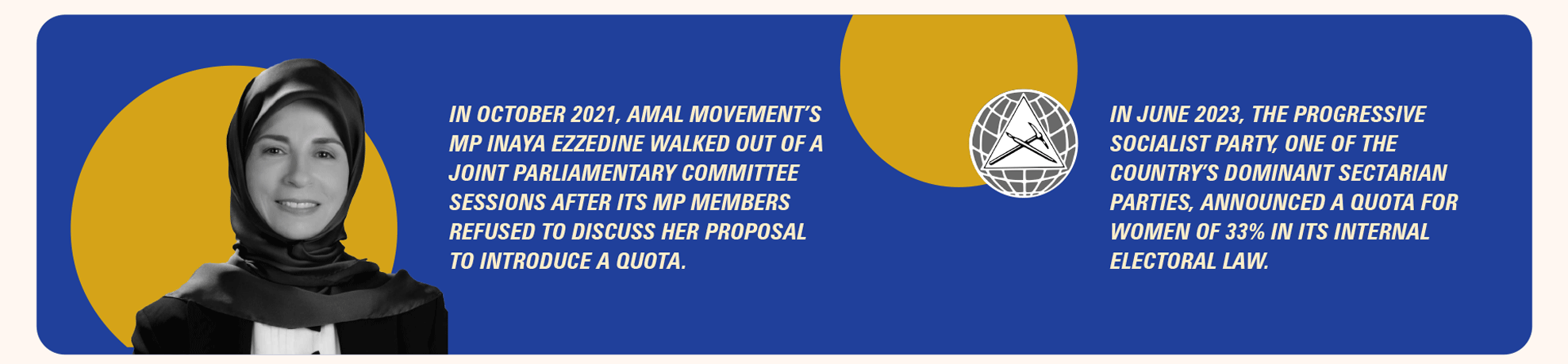
This proposal was submitted by Inaya Ezzeddine. Amal Movement’s MP Inaya Ezzedine walked out of a joint parliamentary committee session after its MP members refused to discuss her proposal. Ezzedine withdrew from the session because the deputies—including fellow Amal MPs—refused to even discuss the quota while paying daily lip service to women’s participation in politics.

Arrival of 8 women to parliament in 2022, four of which are labeled “change MPs”.

+ Read More

While none of the 8 MPs hold an explicitly feminist agenda and that the women did not reach parliament with a common vision, it is expected from the four women “Change MPs” to challenge the patriarchal status quo. This yet remains an ambitious aspiration amid the sectarian and political divisions in the country.

One of the four women “Change MPs”, was subject to repeated incidents of sexual harassment by her male peers in the parliament.

Zarazir took to Facebook to talk about a number of incidents that showed “disrespect” and “harassment” by her male peers over the last few months.

PSP and Kataeb

Two of the country’s dominant sectarian parties. The PSP announced a quota for women of 33% in its internal electoral law, whereas, the Kataeb instated a 20% quota for women.

However, both parties largely operate like a patriarchal family business, where leadership is passed from father to son, and the number of women candidates they have field in parliamentary elections over the years remains very limited.

Maya Zaghrini – Lebanese forces

Elected on the 13-member Executive Council and was also appointed as the party’s representative of the Mount Lebanon district.

Noteworthy that 2 of the 8 women who won seats in the Lebanese parliament after the 2022 elections are affiliated with the Lebanese Forces.

Three factors need to be taken into account when analyzing women’s political participation:

  • Political parties need to modernize their structure. Most of them with archaic structures haven’t undergone any significant re-structuring since their founding decades ago.
  • They need to strengthen their political support in particular among the younger sectors of their electoral bases. After the setbacks they endured in 2019 as a result of the months long uprising that took over the country.

The backlash these parties received as a result of their incompetent and corrupt governance, and complicity in the current devastation of the country, could have given rise to a decision to facelift said parties’ structures. By this logic, the parties’ instating of the internal gender quotas could be an attempt to market their image among the young sectors of their communities.

  • While internal gender quotas are mostly cosmetic changes that do not necessarily translate to significant and enduring change, there is a need to point out to the fact that some of these women have substantial history and experience within their respective parties, while being continuously exposed to and inspired by other women – namely feminist – in similar positions in global political fora, and within Lebanese feminist civil society.


Tactics

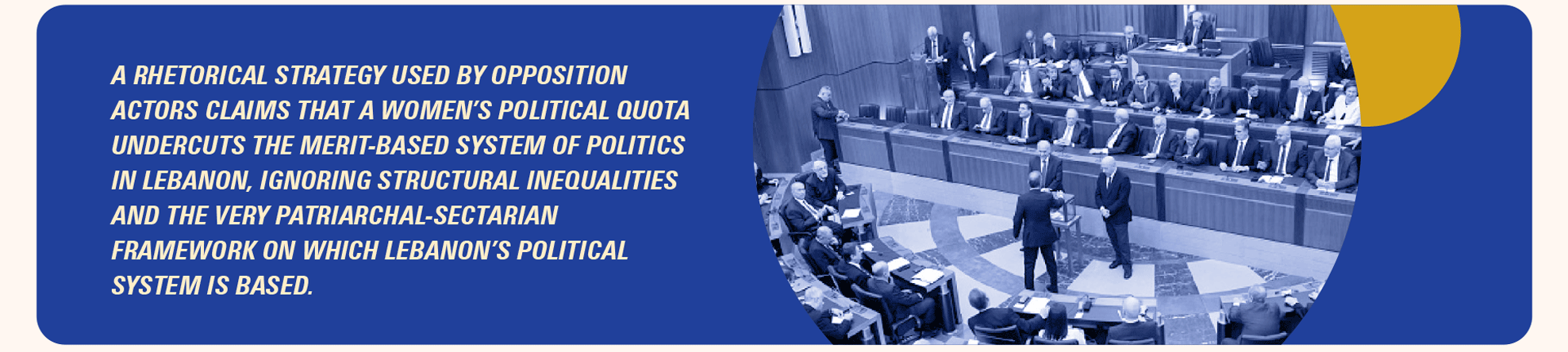
The political system in Lebanon discourages power sharing with women. The ruling class has relied on confessional considerations and sectarian fearmongering as the cornerstone of its hold on power. Mobilizing the people for elections happens on narrow sectarian basis amid the absence of a clear agenda for candidates. As a result, the role of women, which becomes secondary, is diminished and voters elect on confessional considerations amid the sectarian struggles in the country.

As such, the levels of power used in the tactics of policymakers can be divided into three main levels: hidden, visible and invisible.

Countertactics

 Read More
2019 revolution: demands to address systemic discrimination 2020 Charter of Demands by Feminist Activists and Women’s Rights Organizations in Lebanon: the overall absence of women in politics is a primary concern of feminist groups and women’s rights organizations Women’s rights NGOs: calls for a women’s parliamentary quota also draw from the historical legacy of civil society campaigning for this right. NCLW: NCLW has received significant international support to lead the campaigns in favor of a women’s quota. Change MPs: coalitions they can build inside parliament, in addition to the relationships they have with grassroots movements, will both help in advancing the feminist agenda.